Executive Summary — 8 Key Conclusions — v2.0
40 years of embedded systems in constrained environments. One thesis: changing environment doesn't change constraints. It multiplies them.
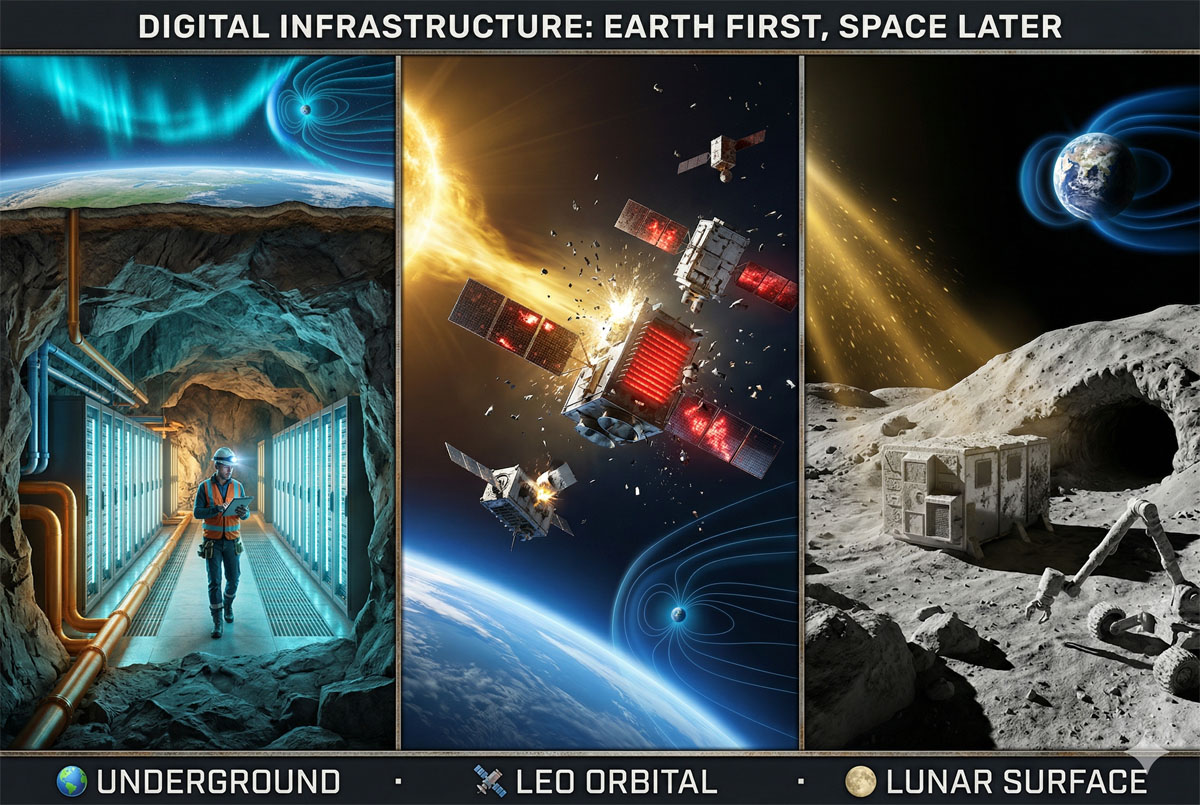
100–400 mSv/yr in LEO vs 1 mSv/yr underground. Triple Modular Redundancy triples all costs. Vacuum cooling: ESA says "unprecedented". Non-negotiable physics.
$25B TERAfab, 80% for space, no demonstrated customers, no timeline. Underground EGS: $0.8–1B for 50MW, proven ROI in 10–12 years, existing market.
99.99% SLA requires technician access. LEO: irreparable. Moon: 6–18 months intervention. 1967 Outer Space Treaty assigns liability to launch state, not operator.
700–1500km: chain-reaction debris multiplication already active. 40,000+ tracked, 130M+ invisible. 18-month GPU refresh = new constellation every cycle.
Solar Cycle 25 peak. May 2024: LEO tracking impossible for days. No magnetosphere above 550km. Underground: natural Faraday + rock + magnetosphere = free.
Rad-hard and DRAM share no foundries, no processes, no economies of scale. $10K–$100K/unit vs $300–500 DRAM. 65–180nm nodes vs sub-10nm commercial.
Economic refresh: 2–3 years. Physical lifespan: 5–6 years. MRAM supply gap: ×10,000. Permanent capital destruction machine.
100 GW/year needs 25,000 Starship flights/year — 68/day. Approved: 69/year. Critical materials (In, Ta, Ge, Co) unmodelled.
Geothermal
550km
Surface
TERAfab — Announced Today
Elon Musk officially launched TERAfab in Austin, Texas. The announcement confirms our analysis on a crucial point.
$20–25B investment · 2nm process node · 1 terawatt/year target · Tesla + SpaceX + xAI joint venture · 20% Earth (AI5 chips) · 80% Space (D3 orbital chips) · SpaceX IPO $50B summer 2026.
No production timeline · No D3 chip radiation qualification published · No demonstrated space datacenter customers · A greenfield 2nm fab takes 4–5 years minimum · Musk has zero semiconductor manufacturing background.
The key paradox: TERAfab inadvertently validates this white paper's core argument. Musk himself acknowledges chip scarcity is the real bottleneck — and his response is a terrestrial, industrial, vertically integrated solution. That is exactly the logic we defend for datacenters: solve problems where they arise, with the laws of physics available, before projecting unproven solutions into space.
Explore All 7 Dimensions
The most advanced technology is sometimes the one that knows where it belongs. Our planet offers for free what no engineering budget can reproduce in space: a magnetosphere, an atmosphere, geothermal energy, water, and humans who can intervene in thirty minutes.