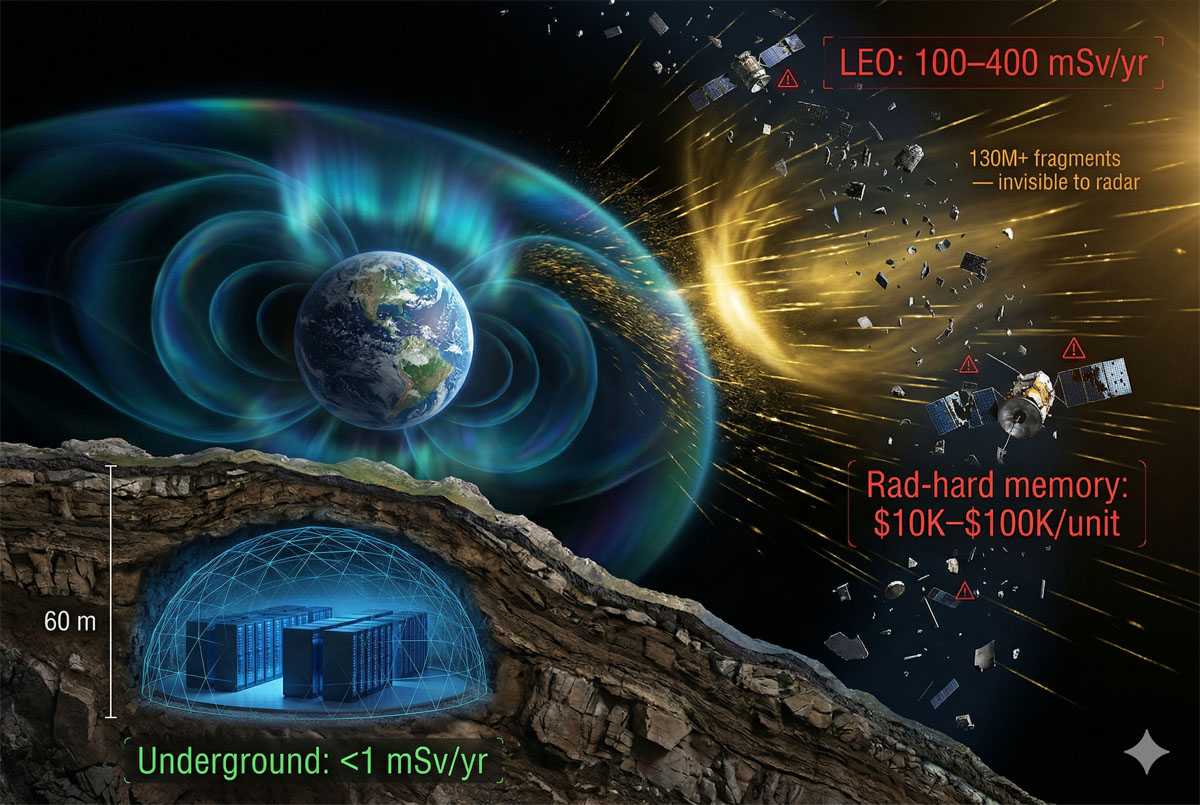
Radiation in LEO: An Incompressible Physical Constraint
Manufacturing your own 2nm chips does not change the laws of orbital physics. TERAfab solves the supply problem — not the radiation problem.
100 to 400 mSv/year in low Earth orbit. Cosmic ray-induced Single Event Upsets (bit flips), permanent junction damage, gate oxide degradation. At 7km/s, even a 1cm fragment carries grenade-level kinetic energy.
Below 60 metres of granite rock + magnetosphere: <1 mSv/year. Natural Faraday cage effect. Zero engineering required. The Earth's magnetosphere deflects 99%+ of solar particle flux free of charge.
The TERAfab paradox on radiation: TERAfab targets 2nm nodes for maximum performance. Space qualification requires 65–180nm nodes due to radiation hardening constraints. These two objectives are physically contradictory. The D3 orbital chips either run on degraded nodes — or require Triple Modular Redundancy that triples all costs.
Triple Modular Redundancy (TMR) — The Hidden Cost Multiplier
| Resource | Standard Design | With TMR | Cost Impact |
|---|---|---|---|
| Silicon area | 1× | 3× | +200% |
| Launch mass | 1× | 3× | +200% |
| Power consumption | 1× | 3× | +200% |
| Thermal dissipation | 1× | 3× | +200% |
| Launch cost (per kg) | $600–2000 | $1800–6000 | ×3 all in |
The Kessler Syndrome: Already Active
This is no longer a future risk. Between 700 and 1,500 km altitude, debris is already generating more debris through chain-reaction collisions.
| Debris Category | Estimated Count (ESA 2025) | Radar Visibility | Impact Energy at 7 km/s |
|---|---|---|---|
| >10 cm | 40,000+ | Yes — tracked | Catastrophic satellite destruction |
| 1 cm to 10 cm | 1,000,000+ | Partial | Full penetration of any hull |
| 1 mm to 1 cm | 130,000,000+ | No — invisible | Solar panel / optics damage |
SpaceX has filed an FCC request for 1 million datacenter satellites. Each satellite, at end of life, adds new debris. An 18-month GPU refresh cycle means a new constellation launch every cycle and a deorbit of the previous one — with residual fragments at every step. There is no proven large-scale debris removal technology today.
Solar Flares: The Systemic Risk of Cycle 25
We are at Solar Cycle 25 peak since late 2024. The May 2024 storm was the first major event of the mega-constellation era — and its effects were sobering.
| Solar Threat | Earth Surface | Underground 60m+ | LEO 550km | Moon |
|---|---|---|---|---|
| Magnetosphere | Partial ✅ | Full + rock ✅ | None ❌ | None ❌ |
| CME particle flux | Attenuated ⚠️ | Protected ✅ | Full exposure ❌ | Full exposure ❌ |
| EMP geomagnetic | Transformer risk ⚠️ | Faraday shielded ✅ | Component destruction ❌ | Component destruction ❌ |
| Annual radiation dose | 1 mSv/yr ✅ | <1 mSv/yr ✅ | 100–400 mSv/yr ❌ | 100–400 mSv/yr ❌ |
| Orbital drift risk | N/A ✅ | N/A ✅ | Fuel burn + possible loss ❌ | Fixed body ✅ |
Rad-Hard Memory: Two Incompatible Markets
The most ignored technical detail in every space datacenter pitch deck. Rad-hard memory and commercial DRAM share absolutely nothing.
| Criterion | Commercial DRAM (HBM4) | Rad-Hard Space Memory |
|---|---|---|
| Process node | <10 nm · 2026 state of art | 65–180 nm · 2016–2020 equivalent |
| Unit price | $300–$500 | $10,000–$100,000 |
| Annual global volume | Billions of units | A few thousand units/year |
| Lead time | 8–39 weeks (2025-26) | 12–24 months |
| Performance relative | 2026 state of the art | Equivalent to 2016–2020 terrestrial |
| Qualification required | None | MIL-STD-883, ESA/SCC, NASA |
| DRAM price trend 2025 | +171% (HBM reallocation) | Not scalable to datacenter volumes |
| EUV process compatible | Yes | No — fundamentally incompatible |
The foundry market reality in 2025–2026: Samsung, SK Hynix and Micron control 95% of global DRAM production. They have massively reallocated capacity toward High Bandwidth Memory for terrestrial AI. DRAM prices rose 171% in one year. No global foundry can absorb a rad-hard memory order at datacenter scale. That market does not yet exist.
The Hidden Operating Cost: 40,000 Avoidance Maneuvers Per Day
Professor Hugh Lewis, University of Birmingham space debris expert, has quantified what a 1-million-satellite constellation requires just to stay alive. The numbers redefine "operational cost."
To avoid objects 10 cm and larger across a 1-million-satellite constellation, Prof. Lewis estimates 40,000 avoidance maneuvers per day — baseline scenario. Upper bound: 100,000 maneuvers/day. Each maneuver burns propellant from a fixed fuel reserve, permanently reducing the satellite's operational lifetime.
Even after a successful avoidance maneuver, the residual collision probability is not zero. At constellation scale, Prof. Lewis concludes: "I would expect quite a few collisions amongst the active satellites, despite all those efforts to avoid them." Each collision generates new debris — further accelerating Kessler conditions.
| Maneuver Scenario | Daily Count | Annual Count | Fuel Impact per Satellite |
|---|---|---|---|
| Baseline avoidance (10cm+ objects) | 40,000 | 14,500,000 | Significant — weeks of operational life lost/year |
| Upper bound scenario | 100,000 | 36,500,000 | Major — constellation lifespan severely shortened |
| Current Starlink (10,000 satellites) | ~400 | ~146,000 | Manageable at current scale |
| Underground datacenter equivalent | 0 | 0 | No maneuvers required. Ever. |
The fuel budget paradox: Every avoidance maneuver consumes propellant allocated for station-keeping and deorbit. A satellite forced into 40 unplanned maneuvers per year — its share in a million-satellite constellation — may exhaust its fuel budget years before its hardware fails. The "5–6 year lifespan" is already an optimistic assumption. The real operational lifetime could be 2–3 years — identical to the economic GPU obsolescence cycle. This eliminates the business case entirely.
The GPU/MRAM Renewal Paradox: A Permanent Capital Destruction Machine
The most overlooked structural flaw of the orbital datacenter model. Two incompatible cycles create a trap with no exit — and no existing supply chain to sustain it.
| Lifecycle Type | Duration | Implication | Terrestrial Equivalent |
|---|---|---|---|
| Physical satellite lifespan | 5–6 years | Minimum before radiation forces replacement | DC facility life: 25–50 years |
| GPU economic competitiveness | 2–3 years | Performance per watt halves vs terrestrial every 2 yrs | Modular GPU swap: 2–4 hours on-site |
| MRAM space-grade lead time | 12–24 months | Constrains build rate regardless of rocket capacity | Commercial DRAM: 8–39 weeks |
| Maneuver-adjusted lifespan | 2–3 years | Fuel exhaustion before hardware failure (see above) | No maneuvers required |
| GPU in-orbit failure rate | 9%/year est. | 90,000 units/year in 1M constellation (Meta study base) | <1%/year — on-site swap |
SpaceX's implicit model: do not repair satellites, replace them entirely. Launch new hardware each cycle. But the economic refresh cycle (2–3 years) is shorter than — or equal to — the fuel-limited operational lifespan (2–3 years). The satellite may be economically obsolete the moment it exhausts its avoidance fuel. Result: a machine that permanently converts capital into debris.
MRAM (Spin-Transfer Torque with Tunnel Magnetoresistance) is the only memory architecture combining radiation immunity, unlimited write endurance, and non-volatility in LEO. It achieves SEU thresholds 84× higher than Flash. But production is boutique: tens of thousands of units/year from 2–3 qualified fabs worldwide.
Space-grade MRAM requires 65–180nm nodes — physically incompatible with TERAfab's 2nm process. Qualification per part: 3–5 years (MIL-STD-883, ESA/SCC, NASA). Cannot be parallelised. Price: $10K–$100K/unit. To sustain 1M satellites with 2-year refresh cycles requires a 4-order-of-magnitude scale-up of a market that does not yet exist.
Indium (In): space solar cells — export-controlled. Tantalum (Ta): rad-hard capacitors — DRC/Rwanda conflict risk. Germanium (Ge): space PV cells — Chinese export restrictions since 2023. Cobalt (Co): MRAM junctions — DRC concentration. Annual consumption for 1M sat refresh: significant fraction of global production.
The FCC Rebuttal: Mathematical Proof Filed on Record
Prof. Hugh Lewis (University of Birmingham) and William Stewart (FCC petitioner) have provided the mathematical foundation for what the white paper describes qualitatively. These are formal filings, not opinion pieces.
Stewart filed a formal Petition to Deny (PC0107515) and a Technical Rebuttal (PC0114210) with the FCC against SpaceX's 1M satellite application. His rebuttal identifies three structural impossibilities now validated by Prof. Lewis:
- Section VI-F — The 0.8% Operational Tax: satellites constantly maneuvering burn propellant and duty-cycle time that should be spent on data processing
- Section VI-H — LEO Monopolisation: SpaceX's replacement flux essentially "claims" all of LEO, making safe launch impossible for anyone else
- Section VI-I — The Debris Factory: at 1M satellites, even 99.9% reliability leaves thousands of dead, unguided projectiles
Lewis's LinkedIn article "One million satellites perform billions of manoeuvres" provides the quantitative foundation. Key findings:
- Conjunctions grow exponentially, not linearly, with satellite count — at 1M units the conjunction rate is catastrophically beyond current management capacity
- "Replacement Flux": constant launch-and-deorbit transit of hardware creates permanent LEO congestion
- Zero failure rate statistically impossible at this scale — 99.9% success still means thousands of dead satellites
- Kessler Syndrome at 1M density: "a mathematical near-certainty"
| Concept | Stewart's FCC Filing | Lewis's Mathematical Proof | White Paper Section |
|---|---|---|---|
| Maneuver paradox | 0.8% operational tax — fuel burned = compute lost ❌ | Conjunctions grow exponentially — not linearly ❌ | Physics § Maneuvers |
| LEO monopolisation | Replacement flux claims all LEO ❌ | No room for other operators ❌ | Physics § Kessler |
| Debris factory | 99.9% = thousands of dead satellites ❌ | Kessler near-certainty at 1M density ❌ | Physics § Kessler |
| Impossible cadence | Launch rate physically unachievable ❌ | Manoeuvre rate exceeds any known system ❌ | Economics § Starship Math |
Stewart's FCC filings transform the physical arguments of this white paper into formal legal objections on record with the US Federal Communications Commission. The FCC must address them before granting or denying SpaceX's license. Prof. Lewis's mathematical work provides the evidentiary basis. The conjunction growth rate is not a model assumption — it is measured data from SpaceX's own semi-annual FCC filings, doubling every 6 months through the current Starlink constellation. At 1 million satellites, Lewis projects billions of manoeuvres per year — each one consuming propellant, each one adding uncertainty to the orbital environment, each one potentially shortening the operational life of the satellite below its economic refresh cycle.