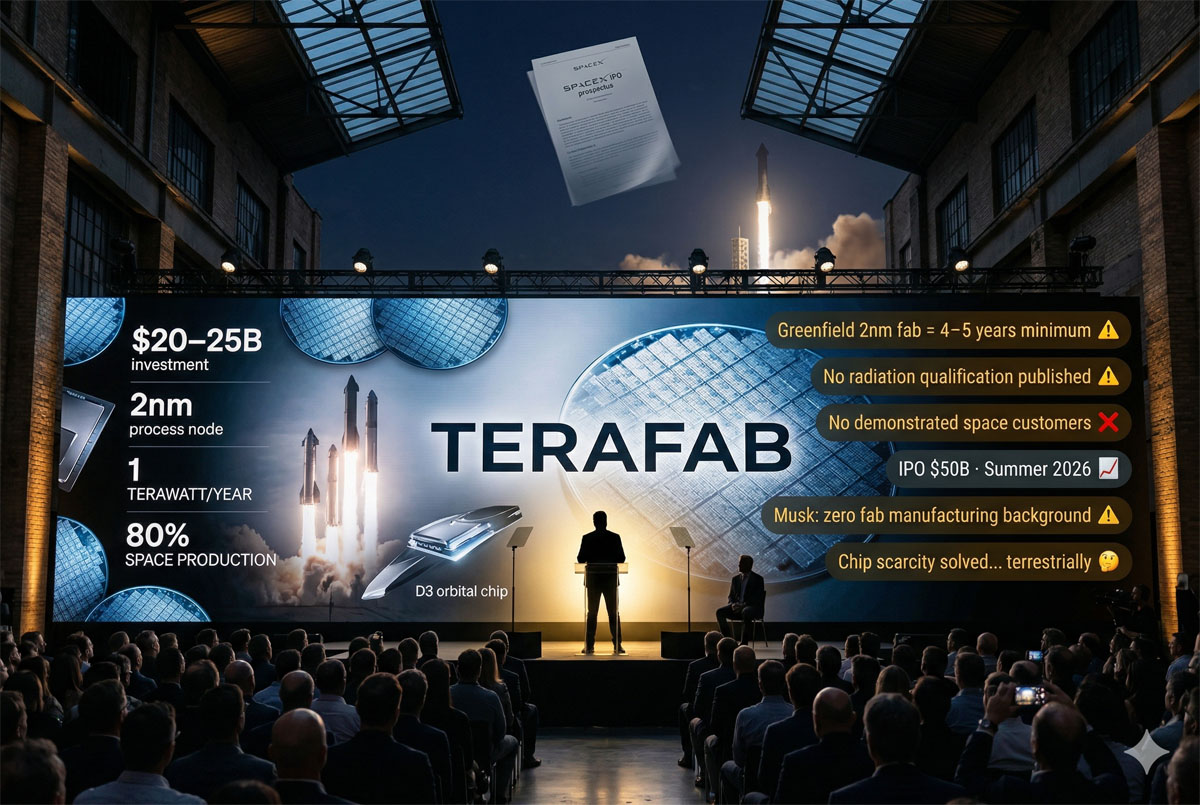
TERAfab: Announced Today — Analysis in Real Time
Elon Musk took the stage at Austin's former Seaholm Power Plant. The most ambitious semiconductor announcement in history. Let's look at the facts.
| TERAfab Parameter | Announced Value | Reality Check |
|---|---|---|
| Investment | $20–25 billion | TSMC Arizona alone costs $65B+ ⚠️ |
| Process node | 2 nanometers | Musk has zero fab manufacturing background ⚠️ |
| Production target | 1 terawatt/year | Exceeds combined global capacity through 2030 ❌ |
| Space allocation | 80% for space | No demonstrated space datacenter customers ❌ |
| Launch timeline | "Launched" March 21 | Greenfield 2nm fab = 4–5 years minimum ❌ |
| D3 orbital chips | Custom for harsh orbital env. | No radiation qualification published ❌ |
| SpaceX IPO | $50B · Summer 2026 | Space DC = IPO narrative driver ⚠️ |
| 1M satellite FCC request | Datacenter constellation | No orbital impact study published ❌ |
| MRAM supply chain (D3 chips) | Space-grade memory assumed | 2nm fab ≠ 65–180nm MRAM — incompatible processes ❌ |
| GPU refresh cycle economics | Not addressed in filing | 2–3yr economic obsolescence vs 5–6yr physical life ❌ |
| Maneuver fuel budget | Not disclosed | 40K avoidance maneuvers/day exhaust reserves ❌ |
What TERAfab Inadvertently Confirms
TERAfab paradoxically validates a key argument of this white paper: Elon Musk himself acknowledges that chip scarcity is the real bottleneck. His response — manufacturing his own components — is a terrestrial, industrial, vertically integrated answer. That is exactly the logic we defend for datacenters.
80% of a $25B facility destined for space — with no demonstrated customers, no contractable SLA, no solution to Kessler risk, no radiation qualification published, and no production timeline. For comparison: a 50MW underground geothermal DC costs $0.8–1B with existing customers and a 10-year proven ROI.
The MRAM paradox TERAfab ignores: TERAfab targets 2nm for D3 space chips. Space-grade MRAM — the only memory compatible with LEO radiation — requires 65–180nm. No single foundry can operate both processes on the same line. TERAfab solves the logic chip supply problem. It does not solve — and does not even address — the memory supply chain problem. The global space-grade MRAM market produces tens of thousands of units per year. 1 million satellites require hundreds of millions. That ecosystem does not exist. TERAfab does not build it.
The announcement precedes the proof. The IPO precedes the wafer. The narrative precedes the physics. Forty years of field experience have taught me to distinguish between the two.