The Moon: Scientific Potential vs Commercial Reality
The author does not dismiss lunar potential. Scientific embedded use cases have genuine intrinsic logic. Mass-market datacenters do not.
Far-side telescopes: shielded from Earth radio frequency interference. Asteroid detection: uninterrupted, atmosphere-free. On-board scientific computing: internal latency acceptable. Very long-term archiving in lava tubes: stable temp, radiation shielding. Horizon: 2045–2060 with validated support infrastructure.
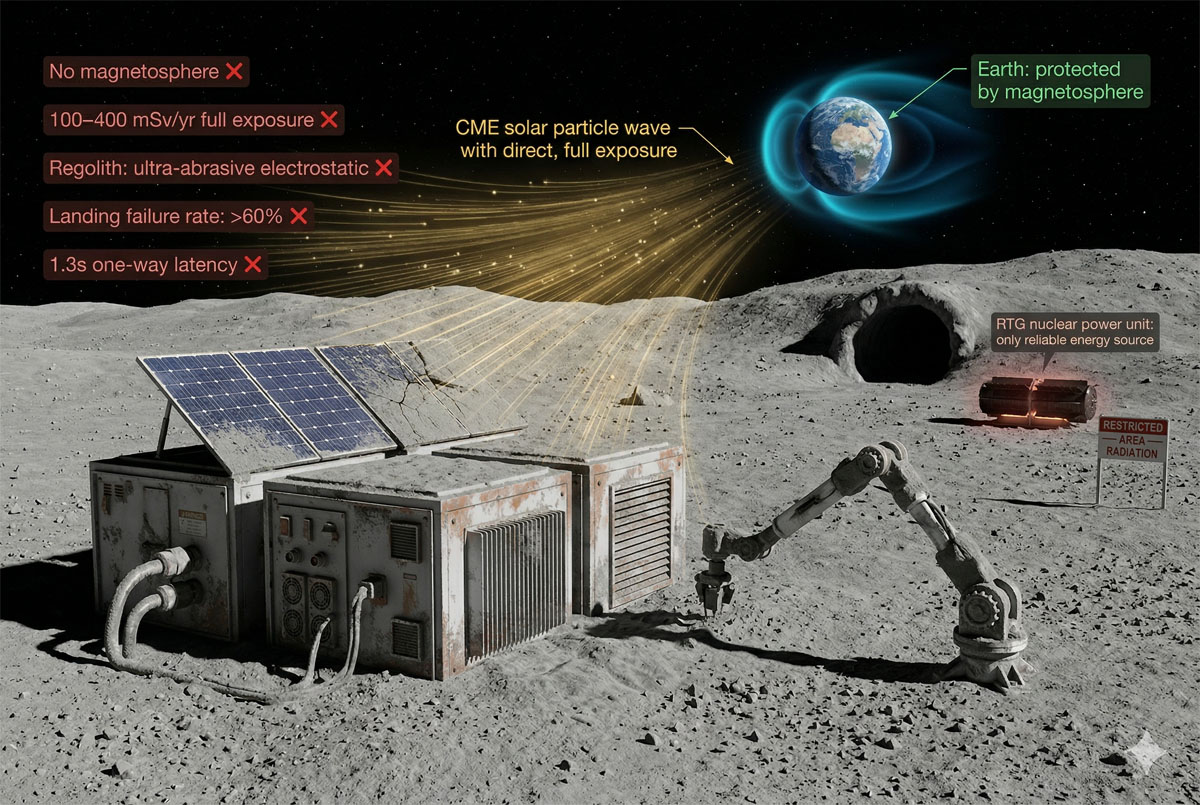
>60% landing failure rate 2019–2025. Lunar regolith: ultra-abrasive, electrostatic, destroys all mechanisms. No magnetosphere: same radiation as LEO surface. 1.3-second one-way latency: eliminates 95% of commercial use cases. No operational energy source for far side.
Lunar Datacenter — Obstacles as of March 24, 2026
| Obstacle | Severity | Status March 2026 |
|---|---|---|
| Landing success rate | Critical ❌ | >60% failure rate — 10 attempts 2019-2025 |
| Lunar regolith | Critical ❌ | Ultra-abrasive, electrostatic — no industrial solution |
| Far-side energy | Critical ❌ | No solar access. Nuclear compact not deployed at scale. |
| Latency | Critical ❌ | 1.3s one-way. Eliminates 95% commercial use cases. |
| Maintenance | Critical ❌ | ISS EVA: $M + months prep per component. Moon: 6–18 months. |
| Radiation protection | Critical ❌ | No magnetosphere — same as LEO surface (100–400 mSv/yr) |
| SLA achievable | Impossible ❌ | No insurer. No jurisdiction. No intervention logistics. |
| Lava tube access | Unknown ⚠️ | LRO radar data confirms existence — never physically explored |
Realistic timeline for operational and reliable scientific lunar datacenters: 2045–2060, subject to a minimum of 2 years of continuous support infrastructure validation first. Timeline for mass-market use: undefined.
Lunar Dust: The Obstacle Nobody Models
Apollo and Lunokhod rovers saw their systems degrading within weeks. No business plan models its impact on server racks, connectors and cooling systems over 10 years.
Lunar regolith is electrostatically charged and ultra-abrasive with sharp, non-weathered edges. It infiltrates all mechanisms. The Moon has no wind to round the particles — unlike Earth's sand. Every connector, fan, cooling loop, and mechanical joint is at risk. This problem has no demonstrated industrial solution at the scale required for a datacenter.